About AB 249, the California DISCLOSE Act
Fight Dark Money by stopping political ads from deceiving voters about who pays for them!
AB 249, the California DISCLOSE Act, would let voters know who REALLY is paying for ballot measure ads — on the ads themselves. Authored by Assemblymembers Kevin Mullin (D-San Mateo) and Marc Levine (D-San Rafael) and sponsored by the California Clean Money Campaign, AB 249 would amend the Political Reform Act of 1974. It requires a two-thirds vote of the legislature to pass.
AB 249 replaces AB 14 using language from 2016's AB 700 with three key loophole-closing amendments. AB 700 passed the Assembly on an overwhelming bipartisan vote of 60-15 and then came within one vote of passing the Senate on August 31.
The record amounts of secret money spent in the last election underscore the need to pass the California DISCLOSE Act. Now it's time to build the additional pressure needed to get AB 249 the one extra vote it needs to pass.
No matter what issue you care about — the environment, health care, education, food safety, worker rights, civil rights, or fair taxes — All are dominated by billionaires and special interests that spend unlimited amounts of hidden money to buy elections.
AB 249, the California DISCLOSE Act will start to free California politics from secret money and set an example for the nation.

Clear and Prominent Disclosures on Political Ads
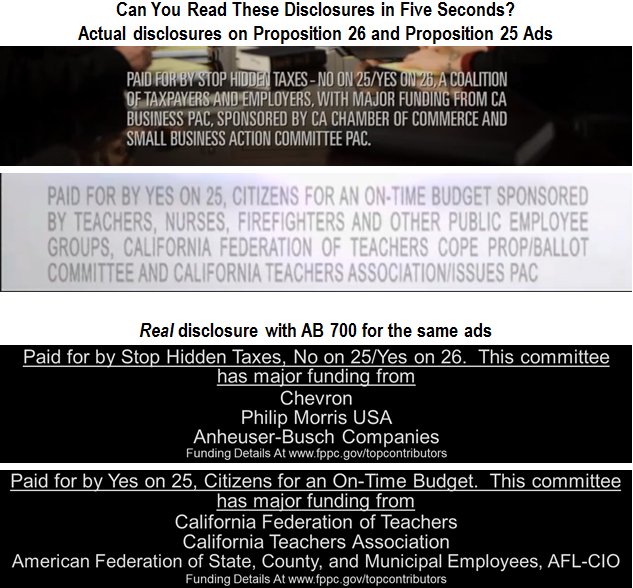
- Requires ads to show 3 largest funders of $50,000 or more in large clear type on a solid background. No more fine print. Applies to all ballot measure ads and to ads about candidates paid for by outside groups.
- On television and video ads disclosures must be shown on a solid black background on the bottom 1/3 of the screen for a full 5 seconds. Each funder must be clearly listed on a separate line in a large Arial font, and in easy to read mixed case (not all capital letters).
- Also applies to ads, print ads, mass mailers, robocalls, and online ads. Radio ads and robocalls must clearly name the two largest funders. Applies whether ads are paid for by corporations, unions, or millionaires.
- Uses new earmarking rules to identify original donors of ballot measure ads so they have to display the true funders instead of misleading names even if funders try to hide behind multiple layers of organizations. The new rules also apply to independent expenditure ads when funders identify the specific committee that pays for the ad.
AB 249 is Constitutional and Reasonable
- 8 out of 9 justices in the Supreme Court's Citizens United decision noted the problems when groups run ads "while hiding behind dubious and misleading names" and said we need transparent disclosure for voters "to make informed decisions and give proper weight to different speakers and messages."
- Required TV ad disclosures are the same time and space as current law — just much more effective.
- Required radio ad disclosures are shorter than those in current law in most cases — but more effective.
- "The California DISCLOSE Act, SB 52, stands on a firm constitutional bedrock and is worthy of support."
— Brennan Center for Justice, 4/24/2013
See our
full comparison to current disclosure law to see how AB 249 is both reasonable and effective.
"Requiring people to stand up in public for their political acts fosters civic courage, without which democracy is doomed."
— Justice Antonin Scalia, writing in Doe v. Reed, 2010
Californians are Ready for the California DISCLOSE Act
- 84% of California voters said they favored legislation to "increase the public disclosure requirements of initiative sponsors to more clearly identify who are its major funders" in the October 13, 2011 Field Poll, including 86% of Democrats, 88% of Independents, and 78% of Republicans.
- Over 100,000 Californians have signed petitions urging the legislature to pass the California DISCLOSE Act.
"The overwhelming power of money to mislead voters is a profound moral issue."
— Reverend Dr. Rick Schlosser, Executive Director of
California Church IMPACT, representing 1.5 million people of faith in California.
Tell voters who is really funding propositions and attack ads when it counts!
| Like Clean Money on Facebook ➨
|
|
Before and After Examples
| Like Clean Money on Facebook ➨
|
|